Sister Den Hartog
About: A woman in nurse's dress who joined Maguire's column at Westerrode on 17 November 1944, was taken by the Germans the next morning, and was held at the Wormshoef, Velp and the Kruisberg until freed at Groningen. ◐ Probably the Rotterdam nurse A. den Hartog of the Dutch Ambulance to Finland in 1940.
Unit or role: A woman known as Sister (zuster), dressed as a nurse, though Ede's history says it never established that she was one; seen at the Wester Wetering at Ede (Boeree p. 162); passenger with the Pegasus II column.
Where: Rotterdam (the 1947 newspapers; ◐ the 1940 lists); the Wester Wetering, Ede (Boeree).
Evidence: ✓ Boeree, Kroniek van Ede (1947), pp. 162, 183–184, 187–189, 203 (checked on the page images); ✓ the Ede manuscript "Het Verzet", pp. 46 and 48 (checked on the images); ✓ De Courant, 7 March 1940, De Standaard and De Nederlander, 28 March 1940, and De Residentiebode, 9 September 1940; ✓ Nijmeegsch dagblad, 18 December 1947.
- ◐ The Dutch Ambulance in Finland, 1940.
- Boeree has her belong to "de Nederlandsche ambulance in Finland" (p. 183, checked on the image). The official staff list of that ambulance (the Dutch field hospital sent to Pälkjärvi in the Winter War, March 1940) has among its nurses "A. den Hartog, te Rotterdam" (De Courant, 7 March 1940, checked on the image; the same list, OCR only, in De Maasbode and De Avondpost of 6 March).
- On 28 March 1940 the papers reported the silver-jubilee dinner at Amsterdam of the Algemeene Nederlandsche Christelijke Ambtenaarsbond, a Christian civil servants' union (De Nederlander, checked on the image). The speaker for its Rotterdam branch brought the congratulations of "het lid dier afdeeling, Zuster Den Hartog, die met de Ned. Ambulance naar Finland is vertrokken" (that branch's member, Sister Den Hartog, who has left with the Dutch Ambulance for Finland) (De Standaard, checked on the image).
- De Residentiebode of Monday 9 September 1940 has the ambulance back at The Hague "gisterenmorgen" (yesterday morning), and its list of the returning nurses prints "A. van Har-tog", ◐ very probably the same nurse with the name misprinted (the report, checked on the page image).
- It is her only initial; no forename, birth or family is given in any source found.
- ◐ Why it is probably her. Three things point one way: Boeree's "Nederlandsche ambulance in Finland", the Rotterdam in the Wormshoef articles of 1947 below, and a nurse called Den Hartog from Rotterdam in that ambulance. Against it, the Ede manuscript says nothing of Finland and says her true name and nursing were never established (below).
With Murphy
Link to the section With Murphy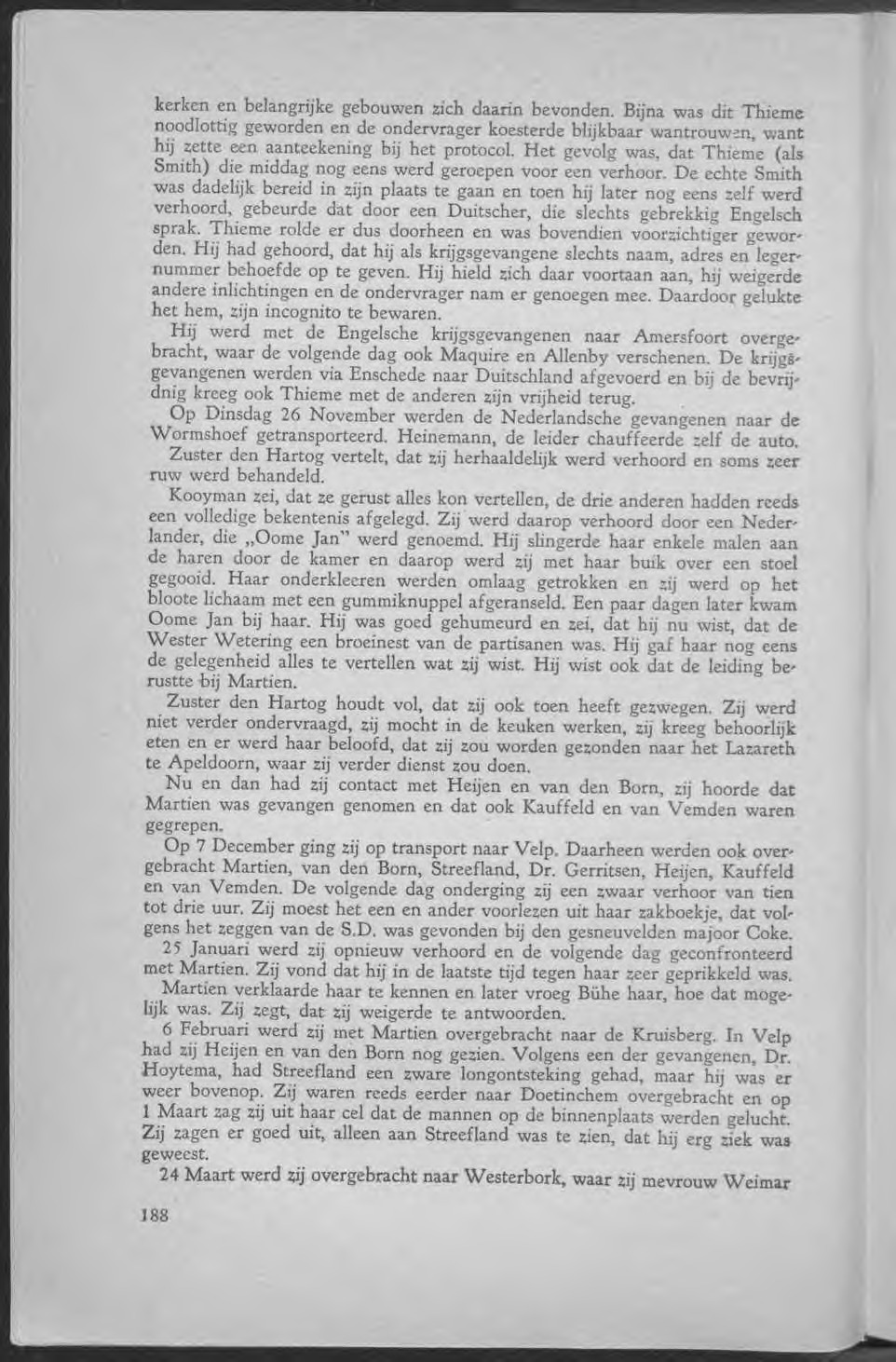
She is not shown with Murphy. She was one of the people on the crossing he was in, and her capture is part of what Pegasus II cost.
- ✓ At the Wester Wetering. Boeree has her at the farm in the autumn: when "Martien" (Abraham du Bois), sent on by Capt. King, came to the Wester Wetering, "na een tijdje haalde zuster den Hartog zijn uniform weg" (after a while Sister Den Hartog took away his uniform) (p. 162, the page); Boeree's other mention of the farm, in the account of her questioning, has the SD calling it "een broeinest van de partisanen", a hotbed of partisans (p. 188).
- ✓ Westerrode, 17 November.
- Waiting for the troop at Westenrode with "Henk van Duin of Twello", really Johan Doorn, who had been given a mission to the south and whose left arm had set at a right angle at the elbow ("onder een rechte hoek vergroeid"), she paced to and fro with him, the two hiding in the shadow of a haystack when a flare went up; Doorn was anxious and Martien, nervous himself, tried to calm him (Boeree pp. 182–183, the arm and the calming on p. 183).
- The column came at nine, two hours late, and she and Doorn joined it; he carried her handbag, the rest of her kit was in her rucksack, and Maguire urged speed (Boeree p. 183).
- Ede's wartime history has her among those who did join, "een in verpleegsterstenue gestoken vrouw" (a woman in nurse's dress), in the company of one of the resistance's top men (Ede manuscript, p. 46, checked on the image).
- From that it concludes: "lijkt ons de veronderstelling gerechtvaardigd, dat ze in dat verzet een belangrijke rol speelde" (the supposition seems justified to us that she played an important part in that resistance). It adds that a group meant to gather at the forester Van de Brink's house that evening arrived late, missed the column and hid in the wood on the 18th (Ede manuscript, p. 46, checked on the image).
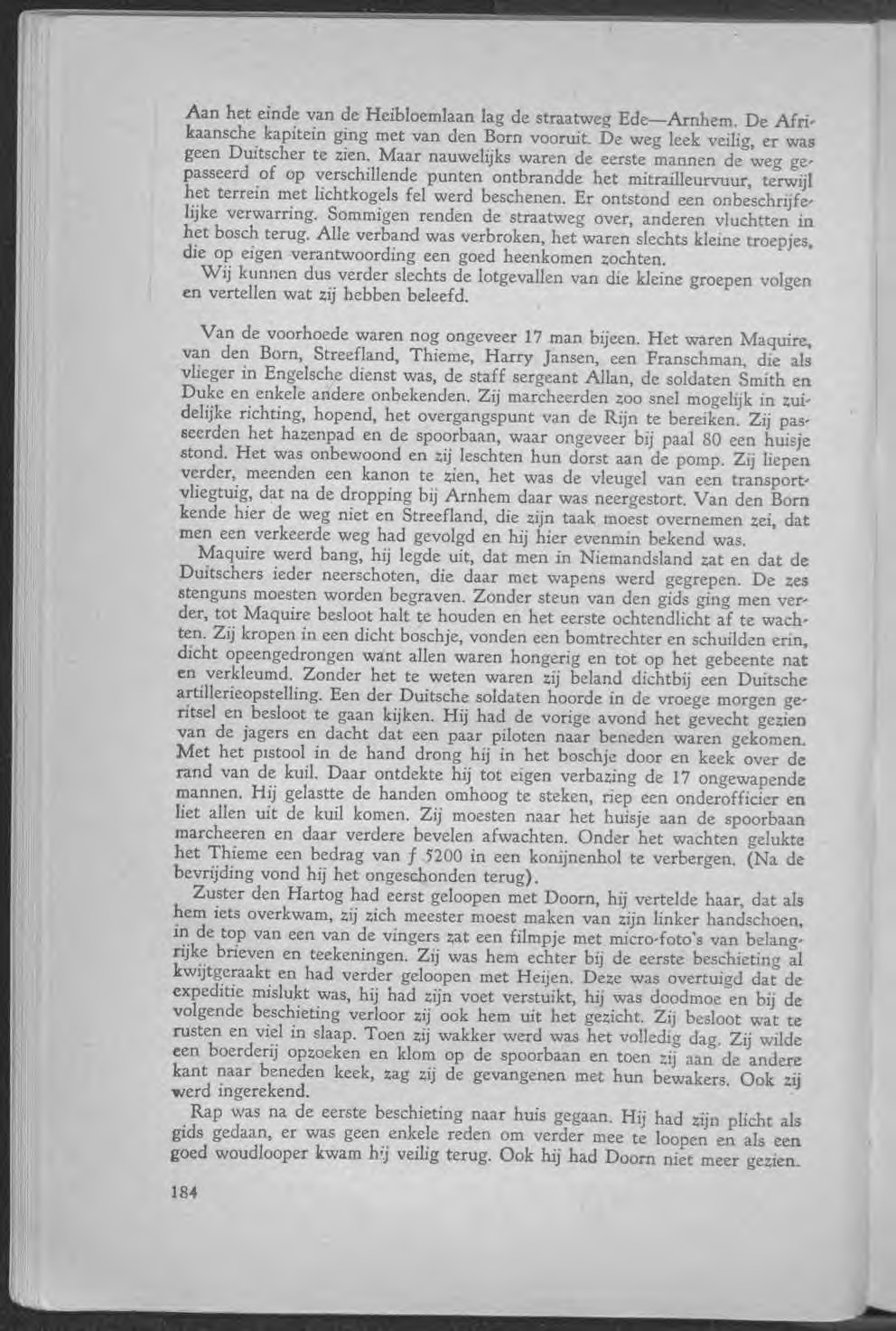
- ✓ Lost in the dark. At the first firing she lost Doorn, who had told her that if anything happened she was to take the left glove, in whose fingertip was a microfilm of important letters and drawings; she went on with Lt Heijen, lost him at the next firing, lay down to rest and fell asleep, and at daylight, climbing the railway bank to look for a farm, saw the prisoners with their guards and was picked up too (Boeree p. 184). The column's story is on Pegasus II and on Hugh Maguire's page.
- ✓ Ede and the Wormshoef.
- The prisoners were brought together in the Feldgendarmerie at Ede: the Dutch among them were Thieme, Heijen, the guides Van den Born and Streefland, Sister Den Hartog and Harry Jansen; "werden zij erg mishandeld, waarbij hun de voortanden uit de mond werden geslagen" (the guides were badly mistreated, their front teeth knocked out; the sentence begins "according to the English soldiers"); the guides, Heijen and Sister Den Hartog then went on to the Wormshoef, a villa the SD was just then taking over (Boeree p. 187).
- The Wormshoef history printed in the Dutch papers in December 1947 names four first prisoners: Van den Born, Streefland, "de lt. vlieger Heyen" (the lieutenant flyer Heyen) and "zustig de Hartog uit Rotterdam" (the paper's misprint for zuster), and says "Alleen zuster de Hartog ontkwam aan de kogel", only Sister de Hartog escaped the bullet (Nijmeegsch dagblad, 18 December 1947, checked on the image, which also has the four in khaki after a night in a barn under Nijkerk).
- ◐ The same history, told while the trial of the Wormshoef's men went on, is in the Provinciale Drentsche en Asser courant, 31 December 1947, OCR only. Sister Den Hartog is in it only as "zuster de Hartog uit Rotterdam".
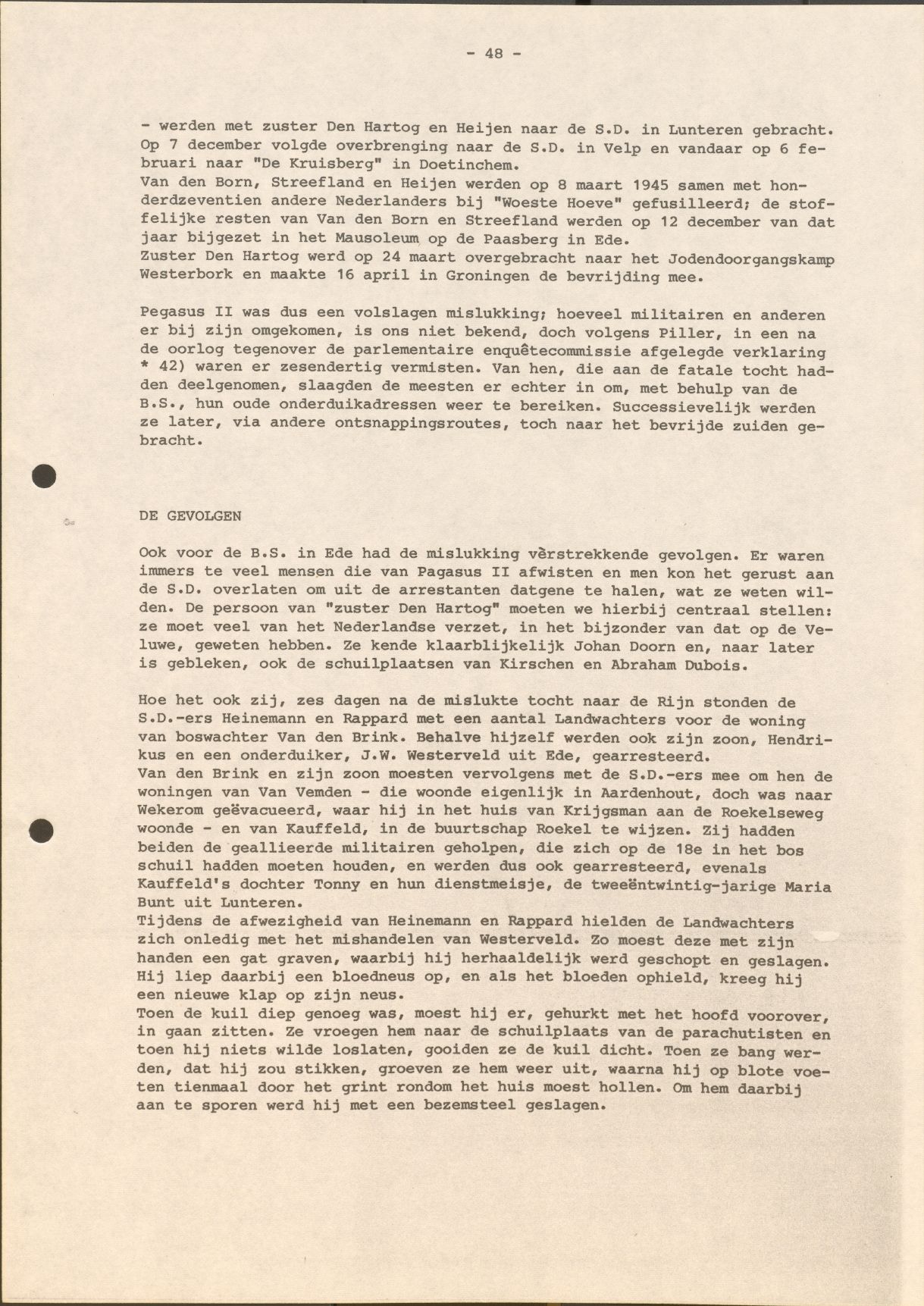
- Boeree p. 188 has the Dutch prisoners taken to the Wormshoef on "Dinsdag 26 November" (a Sunday in 1944); "Heinemann, de leider chauffeerde zelf de auto" (Heinemann, the leader, drove the car himself). Ede's history has the two guides taken "met zuster Den Hartog en Heijen naar de S.D. in Lunteren" (with Sister Den Hartog and Heijen to the SD at Lunteren) (Ede manuscript, p. 48, the page), and puts "De Wormshoef" at Lunteren, in the municipality of Ede (p. 49).
- Now and then she was in touch with Heijen and Van den Born, and she heard that Martien had been taken "en dat ook Kauffeld en van Vemden waren gegrepen" (and that Kauffeld and Van Vemden had been seized too) (Boeree p. 188). Kauffeld and Van Vemden, arrested at Roekel on 24 November for helping the men left behind by the crossing, met her there (p. 203).
- ✓ Interrogation.
- She says she was questioned again and again and sometimes treated very roughly ("soms zeer ruw"): a man named Kooyman told her she might as well tell everything, the three others had confessed; a Dutchman called "Oome Jan" then swung her by the hair across the room and beat her on the bare body with a rubber truncheon; a few days later he said he knew the Wester Wetering was a nest of partisans and that "Martien" led it.
- "Zuster den Hartog houdt vol, dat zij ook toen heeft gezwegen" (Sister Den Hartog maintains that she kept silent then too). She was put to work in the kitchen and promised the Apeldoorn hospital (Boeree p. 188).
- ✓ The diary.
- At the Wormshoef, Boeree writes, Martien complained that she had kept a little diary ("dagboekje"), "waardoor de S.D. verschillende bezwarende dingen was te weten gekomen" (through which the SD had learned various incriminating things). She declared that she had indeed ("inderdaad") had to read a few things from her agenda to the SD, and that after a few minutes she had said no more ("Zij had dat gedaan maar verder na een paar minuten gezwegen") (Boeree p. 203, checked on the image).
- At Velp, on 8 December, she was made to read from her notebook, which the SD said had been found with the dead Major Coke (Boeree p. 188).
- ✓ What Ede's history says she knew.
- Under its heading on the consequences, Ede's history says the failure had far-reaching consequences for the Ede BS and that "De persoon van "zuster Den Hartog" moeten we hierbij centraal stellen" (we must put the person of "Sister Den Hartog" at the centre of this).
- She "moet veel van het Nederlandse verzet, in het bijzonder van dat op de Veluwe, geweten hebben" (must have known much of the Dutch resistance, especially on the Veluwe), "kende klaarblijkelijk Johan Doorn" (apparently knew Johan Doorn) and, "naar later is gebleken" (as later turned out), the hiding places of Kirschen and of Du Bois. The next paragraph opens "Hoe het ook zij" (be that as it may) and turns to the arrests at the forester's house (Ede manuscript, p. 48, checked on the image).
- Beside it: she maintains that she kept silent under questioning (Boeree p. 188) and says she read out only a few things from her agenda (p. 203).
- ✓ Velp and the Kruisberg.
- On 7 December, by her account, she was taken to Velp, with Martien, Van den Born, Streefland, Dr Gerritsen, Heijen, Kauffeld and Van Vemden, and at the Rotterdamsche Bank she and Martien had the two cells opposite the vault where most were put (Boeree pp. 188, 203). On 25 January she was questioned again and the next day confronted with Martien, who declared that he knew her; later Bühe asked her how that could be, and she says she refused to answer (p. 188).
- On 6 February she and Martien were moved to the Kruisberg at Doetinchem; from her cell on 1 March she saw the men, who had been moved to Doetinchem before her, exercised in the yard, only Streefland showing that he had been very ill (p. 188).
- Ede's history takes the two guides, with her and Heijen, to the SD at Lunteren, then on 7 December to Velp and on 6 February to the Kruisberg (Ede manuscript, p. 48); Boeree's other passage has all of them sent to Velp "Even voor Kerstmis" (just before Christmas) (p. 203).
- ✓ What became of the others. Van den Born, Streefland and Heijen were shot at the Woeste Hoeve on 8 March 1945 (Ede manuscript, p. 48); Martien too, per Boeree (p. 203).
- ✓ Westerbork and liberation.
- On 24 March she was taken to the transit camp at Westerbork, where she found Mrs Weimar and Didi Roos; on 11 April she was put on a transport to Groningen, where the Allies freed her (Boeree pp. 188–189, checked on the images); the Ede manuscript has her freed at Groningen on 16 April (p. 48, checked on the image). Nothing was found after that.
- Searched on 15 and 21 October 2026: Delpher (newspapers, 1940 to 1991, and the hits for a nurse of the name near Rotterdam in 1938 and 1944, nothing tying either to her), Kew's catalogue, the text of the NARA helper files already held and the Record Group 242 hits the name sweep turned up (other people of the name); the Arolsen index was not searched, since a woman known by one surname and one initial cannot be told from the many of the name there.
Where the sources disagree
Link to the section Where the sources disagree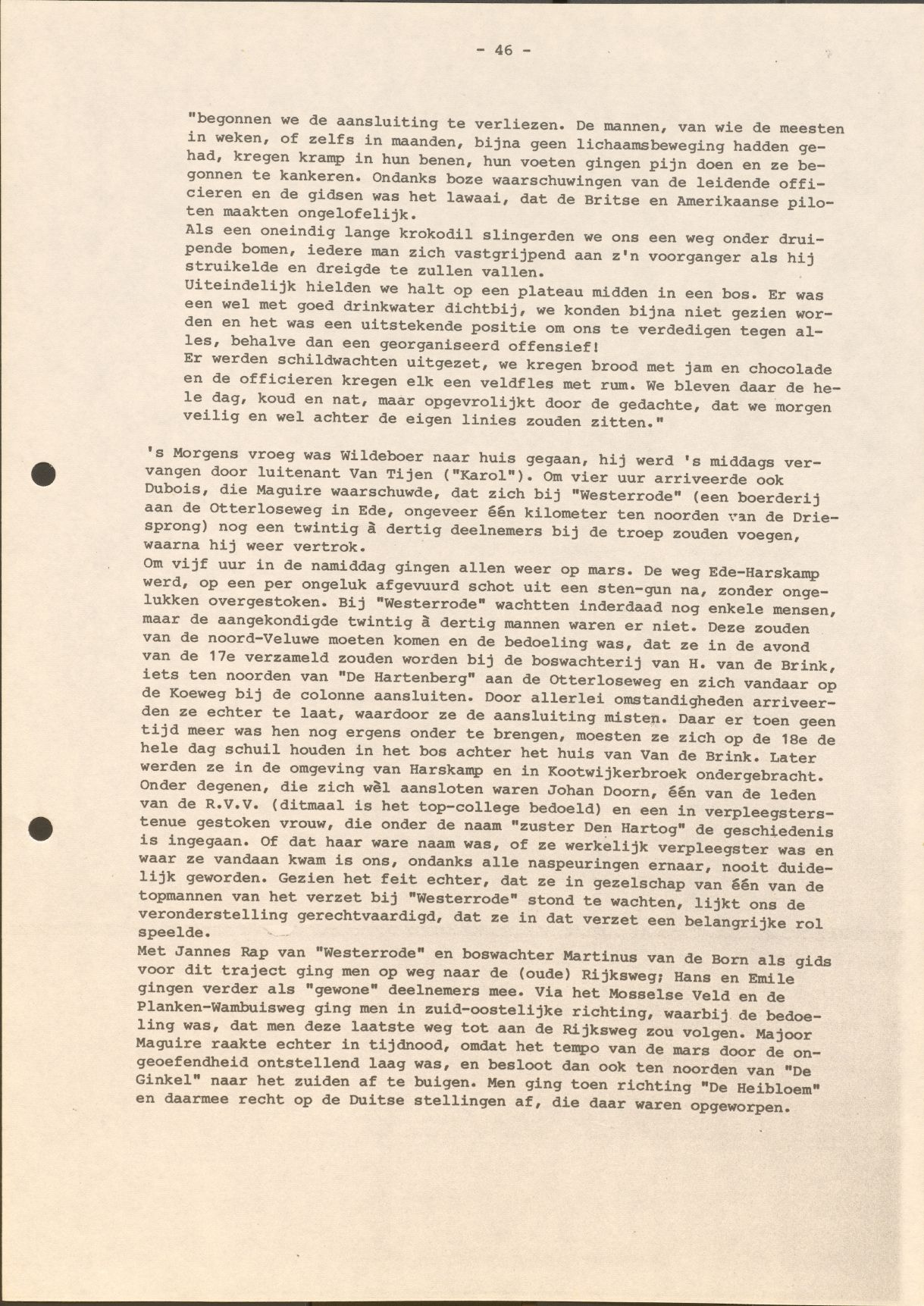
- Who she was.
- Ede's history: "Of dat haar ware naam was, of ze werkelijk verpleegster was en waar ze vandaan kwam is ons, ondanks alle naspeuringen ernaar, nooit duidelijk geworden" (whether that was her real name, whether she was really a nurse and where she came from has never become clear to us despite every enquiry) (Ede manuscript, p. 46, checked on the image). Boeree, the 1947 papers and the 1940 lists give a nurse of that name from Rotterdam, with Finland, and the ambulance's lists have only "A. den Hartog".
- The lists do not say it is the same woman.
- When she reached the Wormshoef. About 19 or 20 November in the Nijmeegsch dagblad's account (the SD arriving about the 19th and the first prisoners, these four, a day later; OCR only); straight after the Feldgendarmerie at Ede in Boeree p. 187, with no date; "Dinsdag 26 November" in Boeree p. 188, a date that was a Sunday.
- When she went to Velp. 7 December in her own account (Boeree p. 188) and in Ede's history (p. 48, for the guides taken with her); "Even voor Kerstmis" in Boeree's other passage (p. 203).
- The dates at Westerbork. Boeree has her sent to Groningen on 11 April and freed there; the Ede manuscript has her liberated at Groningen on 16 April. They fit if 11 April is the transport and 16 April the day Groningen was taken, but neither says so.
- The farm's name. Boeree spells it Westenrode (pp. 182–183), Ede's history Westerrode (p. 46); ◐ one farm, where people were waiting on 17 November in both. She is in both versions as a woman who joined the column there.